 Add to Chrome
 Add to Firefox
 Add to Edge
GRIP-VLM: Group-Relative Importance Pruning for Efficient Vision-Language Models
May 13, 2026
In Vision-Language Models (VLMs), processing a massive number of visual tokens incurs prohibitive computational overhead. While recent training-aware pruning methods attempt to selectively discard redundant tokens, they largely rely on continuous-gradient relaxations. However, visual token pruning is inherently a discrete, non-convex combinatorial problem; consequently, these continuous approximations frequently trap the optimization in sub-optimal local minima, especially under aggressive compression budgets. To overcome this fundamental bottleneck, we propose GRIP-VLM, a Group-Relative Importance Pruning framework driven by Reinforcement Learning. Rather than relying on smooth-gradient assumptions, GRIP-VLM formulates pruning as a Markov Decision Process, employing a Group Relative Policy Optimization (GRPO) paradigm anchored by supervised warm-up to directly explore the discrete selection space. Integrated with a budget-aware scorer, our lightweight agent dynamically evaluates per-token importance and adapts to arbitrary compression ratios without retraining. Extensive experiments across diverse multimodal benchmarks demonstrate that GRIP-VLM consistently outperforms heuristic and supervised-learning baselines, achieving a superior Pareto frontier and delivering up to a 15\% inference speedup at equal accuracy.

EmbodiSkill: Skill-Aware Reflection for Self-Evolving Embodied Agents
May 11, 2026Embodied agents can benefit from skills that guide object search, action execution, and state changes across diverse environments. Since embodied environments vary across layouts, object states, and other execution factors, these skills must self-evolve from trajectories generated during task execution. However, existing skill self-evolution methods are mainly developed in digital environments and often convert trajectories into coarse skill updates. Directly applying this paradigm to embodied settings is problematic, because a failed task execution may reflect not only incorrect skill content, but also an execution lapse in which the agent fails to follow valid guidance. We propose EmbodiSkill, a training-free framework for embodied skill self-evolution through skill-aware reflection and targeted revision. EmbodiSkill interprets each trajectory with respect to the current skill, uses skill-changing evidence to update the skill body, and uses execution-lapse evidence to preserve and emphasize valid guidance. Experiments on ALFWorld and EmbodiedBench show that EmbodiSkill consistently improves embodied task success. On ALFWorld, EmbodiSkill enables a frozen Qwen3.5-27B executor to reach 93.28% task success, outperforming GPT-5.2 used as a direct agent without skills by 31.58%. These results show that skill-aware self-evolution helps embodied agents accumulate reusable procedural knowledge from their own trajectories.
OMGs: A multi-agent system supporting MDT decision-making across the ovarian tumour care continuum
Feb 14, 2026Ovarian tumour management has increasingly relied on multidisciplinary tumour board (MDT) deliberation to address treatment complexity and disease heterogeneity. However, most patients worldwide lack access to timely expert consensus, particularly in resource-constrained centres where MDT resources are scarce or unavailable. Here we present OMGs (Ovarian tumour Multidisciplinary intelligent aGent System), a multi-agent AI framework where domain-specific agents deliberate collaboratively to integrate multidisciplinary evidence and generate MDT-style recommendations with transparent rationales. To systematically evaluate MDT recommendation quality, we developed SPEAR (Safety, Personalization, Evidence, Actionability, Robustness) and validated OMGs across diverse clinical scenarios spanning the care continuum. In multicentre re-evaluation, OMGs achieved performance comparable to expert MDT consensus ($4.45 \pm 0.30$ versus $4.53 \pm 0.23$), with higher Evidence scores (4.57 versus 3.92). In prospective multicentre evaluation (59 patients), OMGs demonstrated high concordance with routine MDT decisions. Critically, in paired human-AI studies, OMGs most substantially enhanced clinicians' recommendations in Evidence and Robustness, the dimensions most compromised when multidisciplinary expertise is unavailable. These findings suggest that multi-agent deliberative systems can achieve performance comparable to expert MDT consensus, with potential to expand access to specialized oncology expertise in resource-limited settings.
Entropy-Guided Data-Efficient Training for Multimodal Reasoning Reward Models
Feb 02, 2026Multimodal reward models are crucial for aligning multimodal large language models with human preferences. Recent works have incorporated reasoning capabilities into these models, achieving promising results. However, training these models suffers from two critical challenges: (1) the inherent noise in preference datasets, which degrades model performance, and (2) the inefficiency of conventional training methods, which ignore the differences in sample difficulty. In this paper, we identify a strong correlation between response entropy and accuracy, indicating that entropy can serve as a reliable and unsupervised proxy for annotation noise and sample difficulty. Based on this insight, we propose a novel Entropy-Guided Training (EGT) approach for multimodal reasoning reward models, which combines two strategies: (1) entropy-guided data curation to mitigate the impact of unreliable samples, and (2) an entropy-guided training strategy that progressively introduces more complex examples. Extensive experiments across three benchmarks show that the EGT-trained model consistently outperforms state-of-the-art multimodal reward models.
Taming Hallucinations: Boosting MLLMs' Video Understanding via Counterfactual Video Generation
Dec 30, 2025Multimodal Large Language Models (MLLMs) have made remarkable progress in video understanding. However, they suffer from a critical vulnerability: an over-reliance on language priors, which can lead to visual ungrounded hallucinations, especially when processing counterfactual videos that defy common sense. This limitation, stemming from the intrinsic data imbalance between text and video, is challenging to address due to the substantial cost of collecting and annotating counterfactual data. To address this, we introduce DualityForge, a novel counterfactual data synthesis framework that employs controllable, diffusion-based video editing to transform real-world videos into counterfactual scenarios. By embedding structured contextual information into the video editing and QA generation processes, the framework automatically produces high-quality QA pairs together with original-edited video pairs for contrastive training. Based on this, we build DualityVidQA, a large-scale video dataset designed to reduce MLLM hallucinations. In addition, to fully exploit the contrastive nature of our paired data, we propose Duality-Normalized Advantage Training (DNA-Train), a two-stage SFT-RL training regime where the RL phase applies pair-wise $\ell_1$ advantage normalization, thereby enabling a more stable and efficient policy optimization. Experiments on DualityVidQA-Test demonstrate that our method substantially reduces model hallucinations on counterfactual videos, yielding a relative improvement of 24.0% over the Qwen2.5-VL-7B baseline. Moreover, our approach achieves significant gains across both hallucination and general-purpose benchmarks, indicating strong generalization capability. We will open-source our dataset and code.
From Context to EDUs: Faithful and Structured Context Compression via Elementary Discourse Unit Decomposition
Dec 18, 2025Managing extensive context remains a critical bottleneck for Large Language Models (LLMs), particularly in applications like long-document question answering and autonomous agents where lengthy inputs incur high computational costs and introduce noise. Existing compression techniques often disrupt local coherence through discrete token removal or rely on implicit latent encoding that suffers from positional bias and incompatibility with closed-source APIs. To address these limitations, we introduce the EDU-based Context Compressor, a novel explicit compression framework designed to preserve both global structure and fine-grained details. Our approach reformulates context compression as a structure-then-select process. First, our LingoEDU transforms linear text into a structural relation tree of Elementary Discourse Units (EDUs) which are anchored strictly to source indices to eliminate hallucination. Second, a lightweight ranking module selects query-relevant sub-trees for linearization. To rigorously evaluate structural understanding, we release StructBench, a manually annotated dataset of 248 diverse documents. Empirical results demonstrate that our method achieves state-of-the-art structural prediction accuracy and significantly outperforms frontier LLMs while reducing costs. Furthermore, our structure-aware compression substantially enhances performance across downstream tasks ranging from long-context tasks to complex Deep Search scenarios.
AgentProg: Empowering Long-Horizon GUI Agents with Program-Guided Context Management
Dec 11, 2025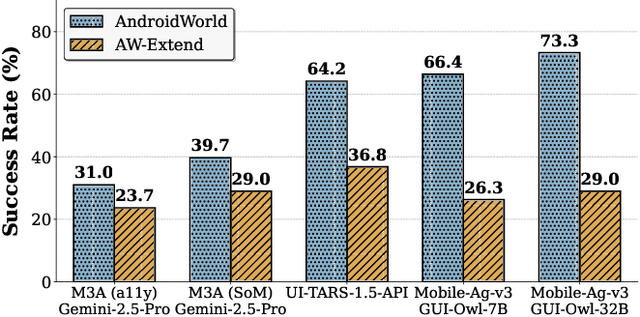
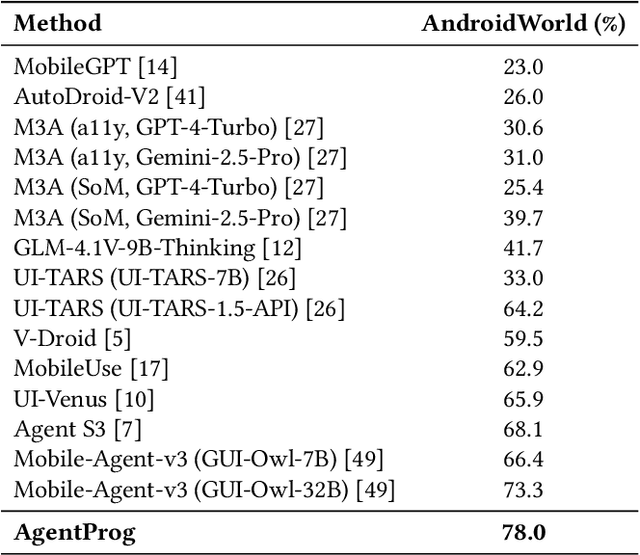
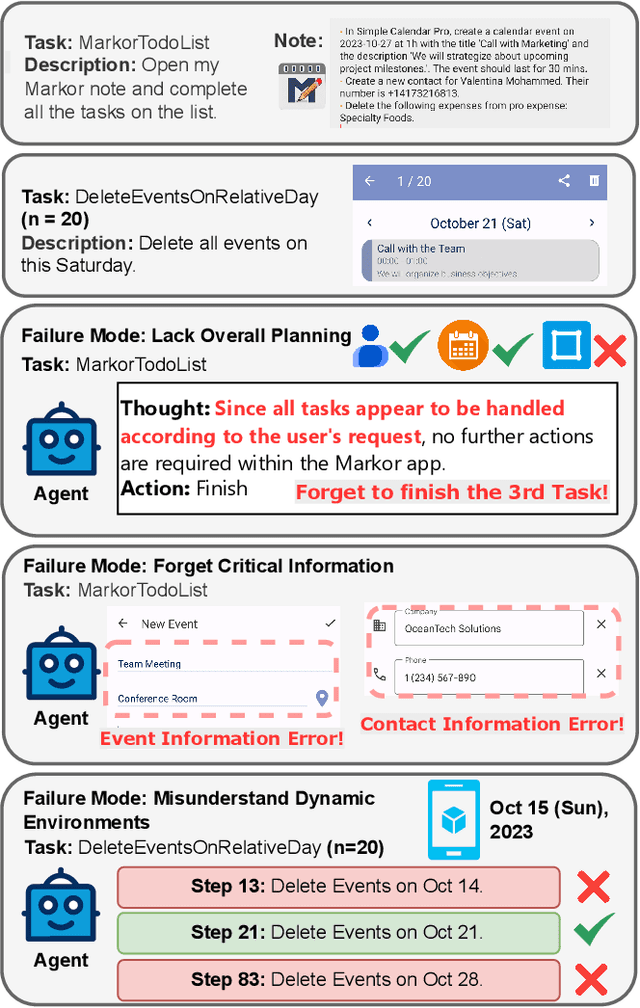
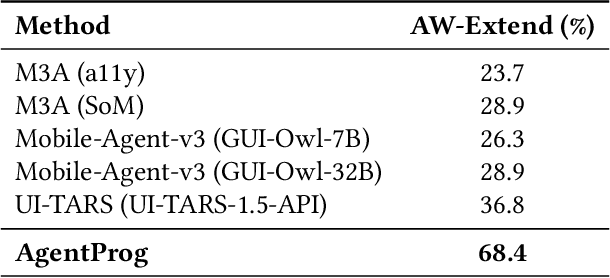
The rapid development of mobile GUI agents has stimulated growing research interest in long-horizon task automation. However, building agents for these tasks faces a critical bottleneck: the reliance on ever-expanding interaction history incurs substantial context overhead. Existing context management and compression techniques often fail to preserve vital semantic information, leading to degraded task performance. We propose AgentProg, a program-guided approach for agent context management that reframes the interaction history as a program with variables and control flow. By organizing information according to the structure of program, this structure provides a principled mechanism to determine which information should be retained and which can be discarded. We further integrate a global belief state mechanism inspired by Belief MDP framework to handle partial observability and adapt to unexpected environmental changes. Experiments on AndroidWorld and our extended long-horizon task suite demonstrate that AgentProg has achieved the state-of-the-art success rates on these benchmarks. More importantly, it maintains robust performance on long-horizon tasks while baseline methods experience catastrophic degradation. Our system is open-sourced at https://github.com/MobileLLM/AgentProg.
How Far are Modern Trackers from UAV-Anti-UAV? A Million-Scale Benchmark and New Baseline
Dec 08, 2025Unmanned Aerial Vehicles (UAVs) offer wide-ranging applications but also pose significant safety and privacy violation risks in areas like airport and infrastructure inspection, spurring the rapid development of Anti-UAV technologies in recent years. However, current Anti-UAV research primarily focuses on RGB, infrared (IR), or RGB-IR videos captured by fixed ground cameras, with little attention to tracking target UAVs from another moving UAV platform. To fill this gap, we propose a new multi-modal visual tracking task termed UAV-Anti-UAV, which involves a pursuer UAV tracking a target adversarial UAV in the video stream. Compared to existing Anti-UAV tasks, UAV-Anti-UAV is more challenging due to severe dual-dynamic disturbances caused by the rapid motion of both the capturing platform and the target. To advance research in this domain, we construct a million-scale dataset consisting of 1,810 videos, each manually annotated with bounding boxes, a language prompt, and 15 tracking attributes. Furthermore, we propose MambaSTS, a Mamba-based baseline method for UAV-Anti-UAV tracking, which enables integrated spatial-temporal-semantic learning. Specifically, we employ Mamba and Transformer models to learn global semantic and spatial features, respectively, and leverage the state space model's strength in long-sequence modeling to establish video-level long-term context via a temporal token propagation mechanism. We conduct experiments on the UAV-Anti-UAV dataset to validate the effectiveness of our method. A thorough experimental evaluation of 50 modern deep tracking algorithms demonstrates that there is still significant room for improvement in the UAV-Anti-UAV domain. The dataset and codes will be available at {\color{magenta}https://github.com/983632847/Awesome-Multimodal-Object-Tracking}.
BudgetThinker: Empowering Budget-aware LLM Reasoning with Control Tokens
Aug 24, 2025Recent advancements in Large Language Models (LLMs) have leveraged increased test-time computation to enhance reasoning capabilities, a strategy that, while effective, incurs significant latency and resource costs, limiting their applicability in real-world time-constrained or cost-sensitive scenarios. This paper introduces BudgetThinker, a novel framework designed to empower LLMs with budget-aware reasoning, enabling precise control over the length of their thought processes. We propose a methodology that periodically inserts special control tokens during inference to continuously inform the model of its remaining token budget. This approach is coupled with a comprehensive two-stage training pipeline, beginning with Supervised Fine-Tuning (SFT) to familiarize the model with budget constraints, followed by a curriculum-based Reinforcement Learning (RL) phase that utilizes a length-aware reward function to optimize for both accuracy and budget adherence. We demonstrate that BudgetThinker significantly surpasses strong baselines in maintaining performance across a variety of reasoning budgets on challenging mathematical benchmarks. Our method provides a scalable and effective solution for developing efficient and controllable LLM reasoning, making advanced models more practical for deployment in resource-constrained and real-time environments.
DyCrowd: Towards Dynamic Crowd Reconstruction from a Large-scene Video
Aug 18, 20253D reconstruction of dynamic crowds in large scenes has become increasingly important for applications such as city surveillance and crowd analysis. However, current works attempt to reconstruct 3D crowds from a static image, causing a lack of temporal consistency and inability to alleviate the typical impact caused by occlusions. In this paper, we propose DyCrowd, the first framework for spatio-temporally consistent 3D reconstruction of hundreds of individuals' poses, positions and shapes from a large-scene video. We design a coarse-to-fine group-guided motion optimization strategy for occlusion-robust crowd reconstruction in large scenes. To address temporal instability and severe occlusions, we further incorporate a VAE (Variational Autoencoder)-based human motion prior along with a segment-level group-guided optimization. The core of our strategy leverages collective crowd behavior to address long-term dynamic occlusions. By jointly optimizing the motion sequences of individuals with similar motion segments and combining this with the proposed Asynchronous Motion Consistency (AMC) loss, we enable high-quality unoccluded motion segments to guide the motion recovery of occluded ones, ensuring robust and plausible motion recovery even in the presence of temporal desynchronization and rhythmic inconsistencies. Additionally, in order to fill the gap of no existing well-annotated large-scene video dataset, we contribute a virtual benchmark dataset, VirtualCrowd, for evaluating dynamic crowd reconstruction from large-scene videos. Experimental results demonstrate that the proposed method achieves state-of-the-art performance in the large-scene dynamic crowd reconstruction task. The code and dataset will be available for research purposes.